
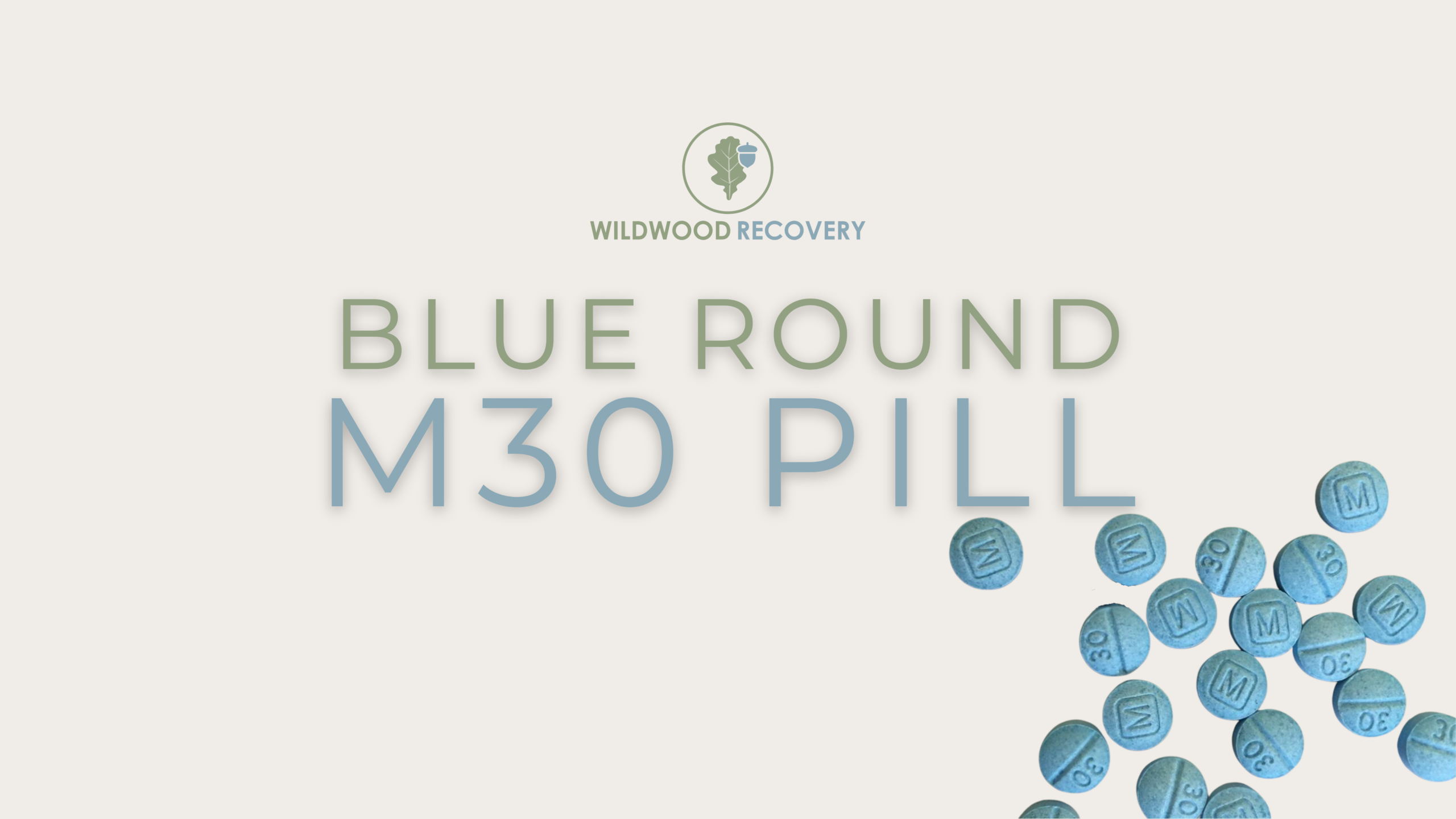
The blue M30 pill is one of the most searched and most dangerous pills in the United States right now. At face value, it’s a prescription opioid used for pain. But in today’s environment, most pills sold as “M30s” are not what they claim to be. Understanding the difference can quite literally save a life.
What Is the Blue M30 Pill?
The pill marked “M” on one side and “30” on the other is identified as:
- Drug Name: Oxycodone
- Dosage: 30 mg (immediate-release)
- Color: Blue
- Shape: Round
- Imprint: “M” / “30”
This is a high-dose opioid prescribed for severe pain, typically in patients with a tolerance to opioids.
Blue M30 Pill at a Glance
| Feature | Details |
|---|---|
| Drug Type | Opioid analgesic |
| Active Ingredient | Oxycodone |
| Strength | 30 mg |
| Color | Blue |
| Shape | Round |
| Imprint | M / 30 |
| Medical Use | Severe pain management |
| Risk Level | Extremely high |
How It Works
Oxycodone binds to opioid receptors in the brain and nervous system. This reduces the perception of pain and can also produce:
- Relaxation
- Euphoria
- Sedation
At 30 mg, this is considered a strong dose, especially for someone without prior opioid exposure.
Why M30 Pills Are So Commonly Misused
These pills are frequently misused because they:
- Deliver a strong euphoric effect
- Act quickly in the body
- Are widely recognized on the street
For many people, M30s become a stepping stone into deeper opioid dependence.
The Reality Today: Most “M30s” Are Fake
Here’s the part that matters most.
A large percentage of pills sold as “blue M30s” are counterfeit.
They are made to look identical to real oxycodone pills, but instead contain:
- Fentanyl
- Fentanyl analogs
- Unknown synthetic compounds
These fake pills are often referred to as “blues” or “dirty 30s.”
Why Counterfeit M30 Pills Are So Dangerous
Fentanyl is significantly more potent than oxycodone. That means:
- There is no consistent dosing
- A tiny amount can cause overdose
- Users often don’t know what they’re taking
Many overdoses today involve people who believed they were taking oxycodone.
Even one pill can be fatal.
Signs of an Overdose
If someone has taken an M30 pill and shows any of the following, it’s an emergency:
- Slow or stopped breathing
- Blue lips or fingertips
- Unresponsiveness
- Gurgling or choking sounds
Call 911 immediately and administer naloxone if available.
Dependence and Addiction Risk
Even when real, oxycodone carries a high risk of addiction.
Signs of developing dependence include:
- Needing more to feel the same effect
- Cravings between doses
- Withdrawal symptoms when stopping
- Continued use despite consequences
Why This Matters for Recovery
For people in recovery, pills like M30s can be especially dangerous because:
- They can trigger relapse quickly
- The potency increases overdose risk after tolerance drops
- Counterfeit pills make outcomes unpredictable
This is one of the main reasons relapse today is more dangerous than it was even a few years ago.
Treatment Options That Help
If opioid use has become a problem, there are effective, evidence-based options:
- Medical detox for safe withdrawal
- Medication-assisted treatment (MAT)
- Residential or outpatient programs
- Ongoing therapy and relapse prevention
Programs like Wildwood Recovery focus on helping people stabilize physically while also addressing the underlying causes of use.
Final Thoughts
The blue M30 pill (oxycodone 30 mg) is no longer just a prescription medication. In today’s environment, it’s often something far more dangerous. Between high addiction potential and the widespread presence of fentanyl-laced counterfeits, this is one of the highest-risk pills currently circulating. If there’s any uncertainty about a pill, the safest choice is not to take it.
Frequently Asked Questions About M30 Pills
What is a blue M30 pill?
It’s a 30 mg oxycodone tablet used for severe pain.
Are M30 pills always oxycodone?
No. Many are counterfeit and contain fentanyl.
Why are they called “dirty 30s”?
Street versions often contain unknown or dangerous substances instead of real oxycodone.
Sources
Sadiq, N. M., Dice, T. J., & Mead, T. (2024). Oxycodone. StatPearls Publishing.
https://www.ncbi.nlm.nih.gov/books/NBK482226/
Mayo Clinic. (2025). Oxycodone (oral route).
https://www.mayoclinic.org/drugs-supplements/oxycodone-oral-route/description/drg-20074193
Centers for Disease Control and Prevention. (2023). Drug overdose deaths with evidence of counterfeit pill use — United States, 2019–2021.
https://www.cdc.gov/mmwr/volumes/72/wr/mm7235a3.htm
Centers for Disease Control and Prevention. (2024). Suspected counterfeit M-30 oxycodone pill exposures — United States, 2017–2022.
https://www.cdc.gov/mmwr/volumes/73/wr/mm7329a2.htm
U.S. Drug Enforcement Administration. (n.d.). One pill can kill.
https://www.dea.gov/onepill
U.S. Drug Enforcement Administration. (2021). Counterfeit pills fact sheet.
https://www.dea.gov/sites/default/files/2021-05/Counterfeit%20Pills%20fact%20SHEET-5-13-21-FINAL.pdf
U.S. National Library of Medicine. (2024). Oxycodone. MedlinePlus.
https://medlineplus.gov/druginfo/meds/a682132.html
U.S. Food and Drug Administration. (2023). OxyContin (oxycodone hydrochloride) prescribing information.
https://www.accessdata.fda.gov/drugsatfda_docs/label/2023/022272s048lbl.pdf