
In the past year a new product has started appearing in smoke shops, online supplement stores, and convenience stores across the United States. These products are often labeled “7-OH tablets” or “7-hydroxymitragynine tablets.” Many are marketed as stronger alternatives to kratom capsules or powders. Because these products are new, heavily marketed, and poorly understood by the public, people often assume they are simply another form of kratom. That is not accurate.
7-hydroxymitragynine (7-OH) is a concentrated alkaloid found in kratom that can produce significantly stronger opioid-like effects than raw kratom leaf. Tablets containing isolated or synthesized 7-OH are increasingly raising concerns among researchers, regulators, and addiction treatment providers.
Understanding what these tablets are, how they work, and where they are legal can help people make safer and more informed decisions.
What Are 7-OH Tablets?
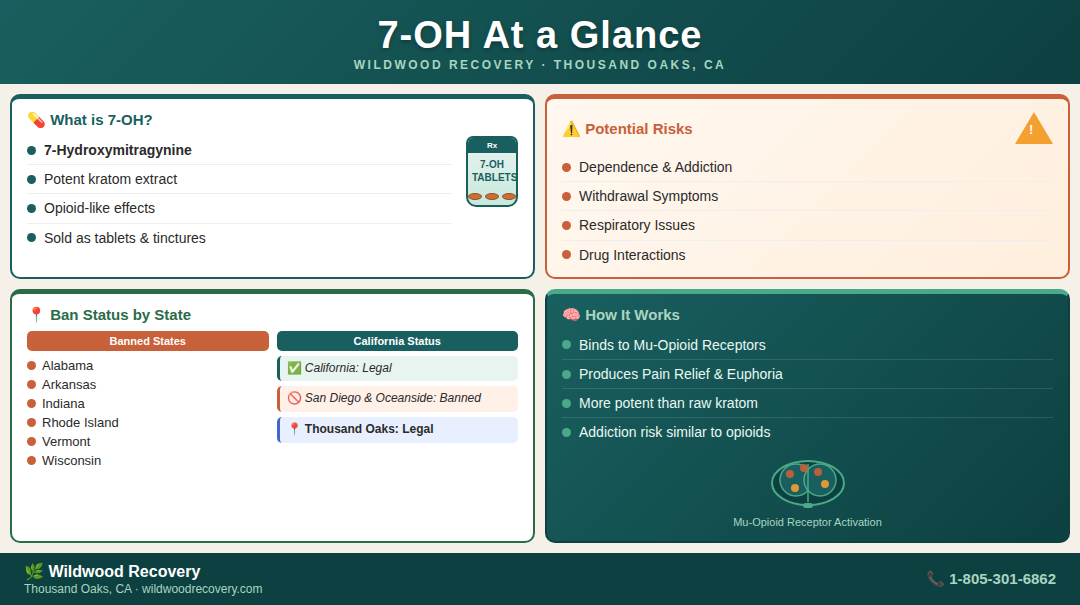
7-OH tablets contain 7-hydroxymitragynine, one of the primary alkaloids derived from the kratom plant (Mitragyna speciosa). In natural kratom leaf:
- Mitragynine is the dominant compound
- 7-hydroxymitragynine exists only in very small amounts
However, many modern products are chemically concentrated or synthesized so they contain far higher levels of 7-OH than occur naturally. Because of that concentration, these tablets are often much stronger than traditional kratom products.
Many products marketed online or in stores claim effects such as:
- “Kratom extract tablets”
- “7-OH shots or tablets”
- “Legal opioid alternative”
- “Extreme kratom potency”
In reality, these products behave pharmacologically much closer to opioid drugs than to traditional kratom tea or powder.
How 7-Hydroxymitragynine Works in the Brain
7-hydroxymitragynine interacts with the mu-opioid receptors in the brain. These are the same receptors targeted by medications such as morphine, oxycodone, and heroin.
This interaction can produce effects including:
- Pain relief
- Sedation
- Relaxation
- Mood elevation
- Euphoria
At higher doses, it may also cause:
- respiratory depression
- nausea and vomiting
- dizziness
- dependence
Because tablets often contain concentrated extracts, the dose delivered can be unpredictable, which increases risk.
Kratom vs. 7-OH Tablets
Many consumers assume these products are interchangeable, but there are major differences.
| Feature | Traditional Kratom | 7-OH Tablets |
|---|---|---|
| Primary compound | Mitragynine | 7-hydroxymitragynine |
| Natural concentration | Low | Highly concentrated |
| Typical form | Powder, tea, capsules | Tablets, extracts |
| Strength | Mild to moderate | Much stronger |
| Dependence risk | Possible | Higher risk |
| Regulation attention | Increasing | Rapidly increasing |
Because of the potency difference, many clinicians consider 7-OH products to be a separate risk category from kratom leaf.
Reported Effects of 7-OH Tablets
People who take these tablets often report effects that resemble both kratom and opioids.
Common short-term effects may include:
- relaxation
- mild euphoria
- pain relief
- fatigue or drowsiness
- mood elevation
Higher doses can lead to:
- heavy sedation
- dizziness
- nausea
- itching
- slowed breathing
In some cases, users report stronger withdrawal symptoms than typical kratom products, especially after repeated use.
Potential Risks and Side Effects
Because 7-OH tablets are new to the market, long-term research is limited. However, early evidence and clinical observations suggest several risks.
Dependence and Withdrawal
Frequent use may lead to:
- tolerance
- physical dependence
- withdrawal symptoms
Withdrawal may include:
- anxiety
- irritability
- insomnia
- muscle aches
- sweating
Dose Uncertainty
Many products are sold as supplements rather than regulated medications, which means:
- labeling may be inaccurate
- potency can vary between batches
- tablets may contain additional alkaloids
Drug Interactions
Combining 7-OH with other substances can increase risk, especially:
- alcohol
- benzodiazepines
- opioid medications
- sedative drugs
These combinations can increase the risk of dangerous sedation or respiratory depression.
Legal Status of Kratom and 7-OH in the United States
The legal landscape around kratom and 7-hydroxymitragynine is complicated and changing quickly. Some states regulate kratom itself, while others have begun focusing specifically on high-potency extracts like 7-OH products.
Kratom and 7-OH Ban Status (Selected States)
| State | Kratom Status | 7-OH / Extract Status |
|---|---|---|
| Alabama | Banned | Banned |
| Arkansas | Banned | Banned |
| Indiana | Banned | Banned |
| Rhode Island | Banned | Banned |
| Vermont | Banned | Banned |
| Wisconsin | Banned | Banned |
These states classify kratom or its alkaloids as controlled substances, which effectively bans both kratom and 7-OH products.
California Kratom and 7-OH Status
| Location | Status |
|---|---|
| California (statewide) | Legal |
| San Diego | Banned |
| Oceanside | Banned |
California does not currently ban kratom statewide, but some cities have local bans.nBecause 7-OH tablets are derived from kratom alkaloids, they generally fall under the same regulatory environment. However, some regulators are beginning to target high-potency extracts separately, which could change the legal landscape in the future.
Why Regulators Are Paying Attention to 7-OH Products
Several factors have brought attention to these tablets:
-
High potency extracts
7-OH concentrations far exceed natural kratom leaf levels.
-
Aggressive marketing
Products are often advertised as strong, legal alternatives to opioids.
-
Rapid market growth
Smoke shops and online retailers have begun carrying multiple brands.
-
Limited safety research
There is little long-term research on concentrated 7-OH consumption.
Because of these factors, several states are considering kratom consumer protection laws or extract restrictions.
Signs of Problematic Use
Some people may begin using kratom or 7-OH products casually but gradually develop patterns of dependence. Warning signs may include:
- needing higher doses over time
- using daily to avoid withdrawal
- difficulty stopping
- spending significant money on products
- continued use despite negative effects
If these patterns develop, it may be helpful to speak with a medical professional or addiction specialist.
Treatment Options for Kratom or 7-OH Dependence
While kratom products are often marketed as natural supplements, dependence can still occur.
Treatment approaches may include:
- medical detox support
- medication assisted treatment when appropriate
- behavioral therapy
- relapse prevention planning
- ongoing recovery support
Treatment is typically tailored to each person’s history, health, and substance use pattern.
Final Thoughts
7-OH tablets represent a new and rapidly growing category of kratom-derived products. While they are often marketed as legal supplements, their pharmacological effects can resemble opioids more than traditional kratom tea or powder. Because these products are concentrated and inconsistently regulated, they carry higher risks of misuse, dependence, and unpredictable dosing.
As awareness grows and more research emerges, regulations and public understanding of 7-hydroxymitragynine products will likely continue evolving. For individuals who find themselves struggling with kratom or extract use, professional support and treatment can help create a safe path forward.
Frequently Asked Questions About 7-OH
What are 7-OH tablets?
7-OH tablets contain 7-hydroxymitragynine, an alkaloid derived from the kratom plant (Mitragyna speciosa). While small amounts occur naturally in kratom leaves, many commercial tablets contain concentrated or synthesized forms of this compound. Because 7-hydroxymitragynine interacts strongly with opioid receptors, tablets may produce much stronger effects than traditional kratom powder or capsules.
Is 7-hydroxymitragynine stronger than kratom?
Yes. In natural kratom leaf, mitragynine is the primary alkaloid, while 7-hydroxymitragynine exists in very small amounts. When isolated or concentrated into tablets, 7-OH can produce significantly stronger opioid-like effects than standard kratom products.
Can 7-OH tablets cause addiction?
Regular use of high-potency kratom extracts such as 7-OH tablets may lead to tolerance, dependence, and withdrawal symptoms. People who take these products frequently sometimes report needing higher doses over time or experiencing symptoms like anxiety, insomnia, and muscle aches when they stop.
What does 7-OH feel like?
People often report effects such as:
- relaxation
- mild euphoria
- pain relief
- sedation
- mood elevation
Because 7-OH strongly interacts with opioid receptors, higher doses may cause drowsiness, dizziness, nausea, or slowed breathing.
Are 7-OH tablets legal in the United States?
The legality of 7-OH tablets generally follows kratom laws, which vary by state. Kratom and its alkaloids are banned in several states including Alabama, Arkansas, Indiana, Rhode Island, Vermont, and Wisconsin. Other states allow kratom but may regulate high-potency extracts.
Is kratom legal in California?
Kratom is legal statewide in California, but a few local jurisdictions have banned its sale. For example, San Diego and Oceanside prohibit kratom products within city limits.
Sources
- Legislative Analysis and Public Policy Association. (2026, January). Kratom: Summary of state laws. https://legislativeanalysis.org/kratom-summary-of-state-laws/
- Henningfield, J. E., Chawarski, M. C., Garcia-Romeu, A., Grundmann, O., Harun, N., Jacobson, A., Swogger, M. T., & Walsh, Z. (2023). Kratom withdrawal: Discussions and conclusions of a scientific expert forum. Drug and Alcohol Dependence Reports, 7, 100142. https://pmc.ncbi.nlm.nih.gov/articles/PMC10311168/
- Kruegel, A. C., Gassaway, M. M., Kapoor, A., Váradi, A., Majumdar, S., Filizola, M., Javitch, J. A., & Sames, D. (2016). Synthetic and receptor signaling explorations of the Mitragyna alkaloids: Mitragynine as an atypical molecular framework for opioid receptor modulators. Journal of the American Chemical Society, 138(21), 6754–6764. https://pubs.acs.org/doi/10.1021/jacs.6b00360
- Ingham, J. (2026, January 16). Kratom & 7-OH ban by state. Brooks Healing Center. https://brookshealingcenter.com/blog/7-oh-ban-by-state-2026/
- Ingham, J. (2025, November 20). 7OH vape: What you need to know. Brooks Healing Center. https://brookshealingcenter.com/blog/7oh-vape/
- National Institute on Drug Abuse. (2024). Kratom. National Institutes of Health. https://nida.nih.gov/research-topics/kratom
- Obeng, S., Kamble, S. H., Reeves, M. E., Restrepo, L. F., Patel, A., Behnke, M., & McMahon, L. R. (2020). Pharmacological comparison of mitragynine and 7-hydroxymitragynine: In vitro affinity and efficacy for μ-opioid receptor and opioid-like behavioral effects in rats. Journal of Pharmacology and Experimental Therapeutics, 372(2), 195–206. https://pubmed.ncbi.nlm.nih.gov/33384303/
- Smith, K. E., Dunn, K. E., Rogers, J. M., Garcia-Romeu, A., Strickland, J. C., & Epstein, D. H. (2022). Assessment of kratom use disorder and withdrawal among an online convenience sample of U.S. adults. Journal of Addiction Medicine, 16(6), 666–670. https://pubmed.ncbi.nlm.nih.gov/35220331/
- U.S. Food and Drug Administration. (2024). 7-Hydroxymitragynine (7-OH): An assessment of the scientific data and toxicological concerns around an emerging opioid threat. https://www.fda.gov/files/drugs/published/7-hydroxymitragynin_7-oh_an_assessment_of_the_scientific_data_and_toxicological_concerns_around_an_emerging_opioid_threat.pdf