
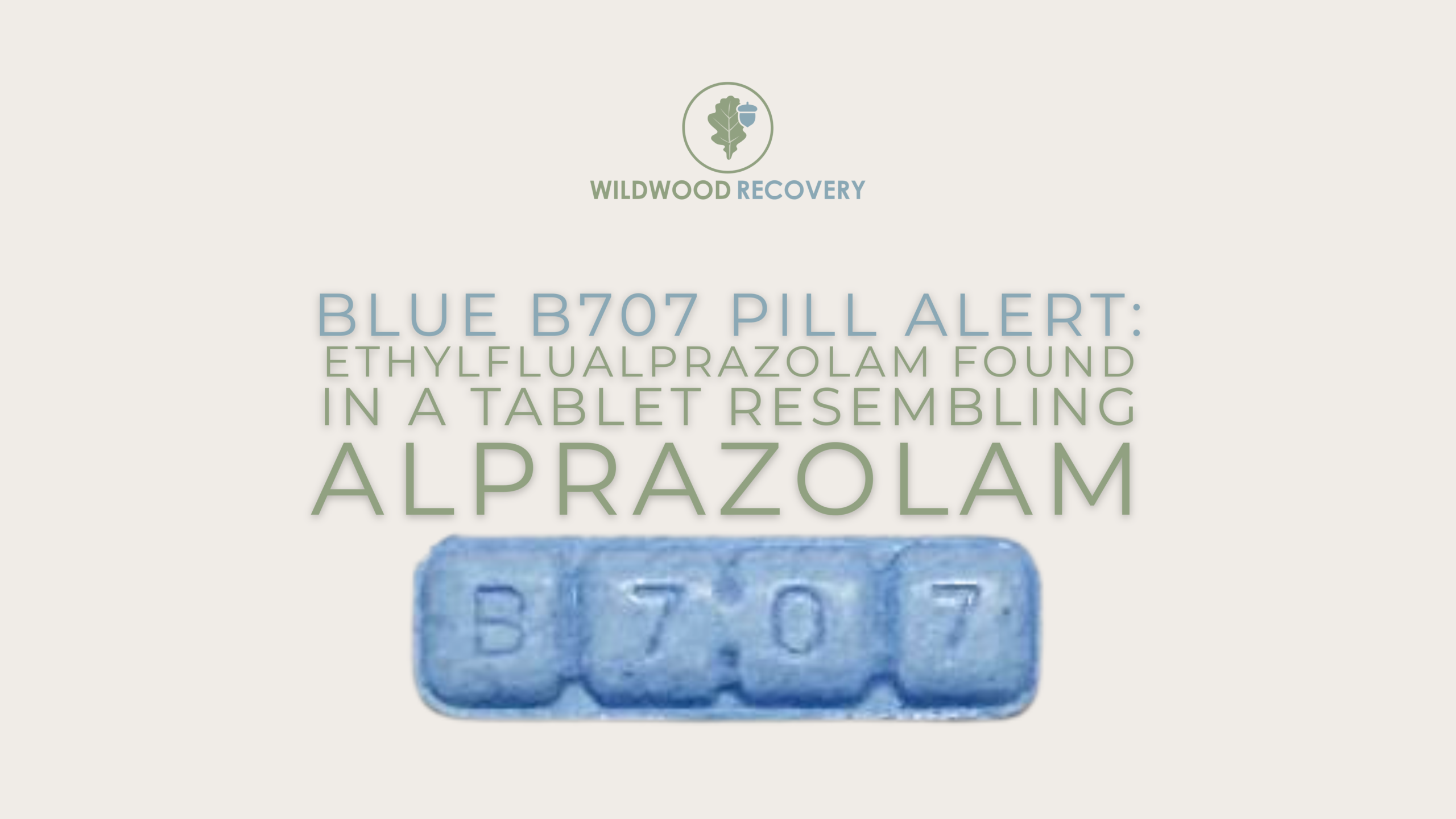
A pill imprint can indicate what a regulated pharmaceutical product is intended to contain. It cannot confirm what is inside a pill purchased from an unregulated source.
That distinction became especially important in April 2026, when the Center for Forensic Science Research and Education’s NPS Discovery program reported identifying ethylflualprazolam in a rectangular blue tablet marked “B707.” The tablet originated in Georgia and also contained 4′-Cl deschloroalprazolam, a second novel benzodiazepine.
B707 is an imprint associated with a 2 mg alprazolam tablet. Finding two novel benzodiazepines in a pill carrying that imprint illustrates why a loose tablet cannot be authenticated by its color, shape, score lines, or lettering alone.
The report concerned one sample analyzed by CFSRE. It does not mean every B707 tablet is counterfeit, nor does it establish that ethylflualprazolam is currently widespread in California. It does show that an unregulated pill can closely resemble a familiar prescription medication while containing different substances.
What Did the Laboratory Confirm?
CFSRE received the drug-material sample on April 6, 2026, and issued its ethylflualprazolam monograph on April 28. Scientists confirmed the identification by comparing the sample with authenticated reference material using gas chromatography-mass spectrometry and liquid chromatography quadrupole time-of-flight mass spectrometry.
The B707 Finding at a Glance
| Question | What the Report Says |
|---|---|
| What did the tablet look like? | It was a rectangular blue tablet labeled “B707.” |
| Where did it originate? | Georgia |
| When was it received? | April 6, 2026 |
| When was the report published? | April 28, 2026 |
| What was identified? | Ethylflualprazolam and 4′-Cl deschloroalprazolam |
| How was ethylflualprazolam confirmed? | GC-MS and LC-QTOF-MS results were compared with authenticated reference material |
| Was a dose reported? | No quantitative dose or alprazolam-equivalent strength was provided in the public monograph |
| Was this a toxicology case? | No. It was a drug-material sample, not a blood or urine specimen from a patient |
| Does it prove widespread circulation? | No. CFSRE reported one drug-material detection at the time of publication |
| Does it establish a California detection? | No. The reported sample originated in Georgia |
The distinction between a laboratory drug-material finding and a clinical overdose case is important. The report confirms the tablet’s appearance and the drugs scientists identified, but it does not provide a clinical outcome, a reliable dose conversion, or evidence that every visually similar pill contains the same mixture.
What Is a Blue B707 Pill Supposed to Be?
DailyMed product labeling identifies B707 as an imprint used on a 2 mg alprazolam tablet. Under that labeling, the tablet is light blue to blue, rectangular, divided by three break lines, and marked B707 on the opposite side.
Alprazolam is the generic medication commonly associated with the brand name Xanax. B707 is a generic-product imprint, not the imprint used on brand-name Xanax.
Alprazolam 2 mg B707 at a Glance
| Category | Pharmaceutical B707 Product |
|---|---|
| Active ingredient | Alprazolam |
| Strength | 2 mg |
| Drug class | Prescription benzodiazepine |
| Tablet appearance under the cited labeling | Light-blue-to-blue rectangular tablet with three break lines, two notches, and the imprint B707 |
| Approved uses of alprazolam | Anxiety disorders and panic disorder |
| Controlled-substance status | Schedule IV |
| Expected effects | Reduced anxiety, sedation, slowed reaction time, and impaired coordination |
| Major warning | Combining alprazolam with opioids, alcohol, or other depressants can cause profound sedation, respiratory depression, coma, or death |
| Dependence risk | Continued use can produce physical dependence |
| Withdrawal risk | Abrupt discontinuation or rapid dose reduction may cause life-threatening withdrawal, including seizures |
| Can appearance prove authenticity? | No. A tablet obtained outside a licensed pharmacy cannot be authenticated by its imprint or appearance alone |
| Safest verification | Medication dispensed by a licensed pharmacy in its original labeled container |
DailyMed’s labeling establishes what a regulated B707 alprazolam product is intended to contain. It does not authenticate a loose tablet obtained from a friend, social-media seller, online market, or other unregulated source.
What Is Ethylflualprazolam?
Ethylflualprazolam is a newly reported triazolobenzodiazepine structurally related to alprazolam and flualprazolam. CFSRE noted that very little published research was available on its pharmacology and potency when the April 2026 monograph was issued. Researchers hypothesized that it may have activity similar to flualprazolam, but that does not establish its dose, strength, onset, or duration in humans.
Ethylflualprazolam at a Glance
| Category | What Is Currently Known |
|---|---|
| Drug name | Ethylflualprazolam |
| Drug class | Novel or designer benzodiazepine |
| Chemical family | Triazolobenzodiazepine |
| Structurally related to | Flualprazolam and alprazolam |
| Established medical dose | None reported |
| Reliable alprazolam equivalent | Not established |
| Known potency in humans | Not established |
| Known onset | Not established |
| Known duration | Not established |
| Reported U.S. finding | Identified in a blue B707 tablet originating in Georgia |
| Other drug found in that tablet | 4′-Cl deschloroalprazolam |
| Direct clinical data | Extremely limited |
| Potential class effects | Sedation, dizziness, memory impairment, poor coordination, confusion, and reduced consciousness |
| Major concern | Unpredictable strength and increased depressant effects when combined with alcohol, opioids, or other sedatives |
| Can naloxone reverse it? | No. Naloxone does not reverse benzodiazepine effects, although it should be used when an opioid may also be involved |
| Can a fentanyl test strip identify it? | No. A fentanyl test strip does not test for ethylflualprazolam |
| Can appearance identify it? | No. Laboratory analysis is required |
The effects in this table are benzodiazepine-class concerns rather than a fully established compound-specific profile. Available alerts emphasize that ethylflualprazolam’s strength and duration remain unknown.
Ethylflualprazolam Has Appeared in Different Drug Markets
The Georgia B707 sample was not the first reported signal involving the substance.
Toronto’s Drug Checking Service first detected ethylflualprazolam on December 16, 2025. During that reporting period, it appeared in three samples that people expected to contain fentanyl. The service described both its strength and the duration of its effects as unknown.
In March 2026, Australia’s CanTEST program found ethylflualprazolam in two bar-shaped tablets that people expected to contain alprazolam. One was a yellow tablet marked R039, and the other was a white tablet marked “XANAX” and “02.” Neither Australian sample contained alprazolam.
The April 2026 Georgia finding added a third type of signal: ethylflualprazolam appearing in a blue tablet carrying the B707 imprint. These reports do not prove that the drug is common, but they show it appearing in multiple countries, different expected drug categories, and several pill designs.
What Is 4′-Cl Deschloroalprazolam?
The second substance found in the Georgia tablet is also a novel benzodiazepine. CFSRE describes 4′-Cl deschloroalprazolam as structurally similar to alprazolam and identifies it as an alprazolam isomer.
Isomers have the same molecular formula but a different arrangement of atoms. That similarity creates an analytical challenge: laboratories may need to examine unique mass-spectral fragments to distinguish 4′-Cl deschloroalprazolam from alprazolam accurately.
4′-Cl Deschloroalprazolam at a Glance
| Category | What Is Currently Known |
|---|---|
| Drug name | 4′-Cl deschloroalprazolam |
| Other name | 4′-chloro deschloroalprazolam |
| Drug class | Novel or designer benzodiazepine |
| Relationship to alprazolam | Structurally similar and an isomer of alprazolam |
| Earlier detection | Identified in Australia in pills collected in December 2021 |
| Recent B707 finding | Detected with ethylflualprazolam in the Georgia tablet |
| Known potency | Not reliably established |
| Known duration | Not adequately established |
| Testing issue | Its similarity to alprazolam can complicate identification without appropriate confirmatory analysis |
| Likely class effects | Sedation, impaired coordination, memory problems, confusion, and reduced consciousness |
| Major risk | Greater harm when combined with opioids, alcohol, or other central nervous system depressants |
| Dependence concern | Repeated benzodiazepine exposure may produce physical dependence |
| Key takeaway | A pill that appears to be alprazolam may contain this compound, another novel benzodiazepine, or a mixture |
CFSRE has linked novel benzodiazepines generally to adverse events and fatalities, particularly when opioids, alcohol, or other depressants are also involved. Direct human data specific to 4′-Cl deschloroalprazolam remain limited.
Ethylflualprazolam vs. Alprazolam
| Category | Ethylflualprazolam | Alprazolam |
|---|---|---|
| Drug type | Novel designer benzodiazepine | Prescription benzodiazepine |
| Approved medical purpose | No established pharmaceutical use described in the available alert | Used to treat anxiety disorders and panic disorder |
| Standardized dose | No | Yes, when manufactured and dispensed as a regulated medication |
| Human research | Very limited | Extensively studied and labeled |
| Known potency | Not established | Clinically characterized |
| Known duration | Not established | Clinically characterized, although effects vary by patient |
| Reliable dose conversion | No alprazolam-equivalent conversion is available | Prescribed in measured milligram strengths |
| B707 association | Found in one B707-style tablet reported by CFSRE | B707 is associated with a labeled 2 mg alprazolam product |
| Contents of a loose tablet | Unknown without laboratory testing | Cannot be assumed merely because the pill carries a pharmaceutical imprint |
| Dependence risk | A serious concern based on its benzodiazepine class, although direct data are limited | Well established |
| Withdrawal risk | Not adequately characterized, but abrupt cessation after repeated benzodiazepine exposure may be dangerous | Established risk of severe and potentially life-threatening withdrawal |
| Risk with opioids or alcohol | Potentially severe or fatal central nervous system depression | Profound sedation, respiratory depression, coma, and death are recognized risks |
| Can appearance verify it? | No | Only pharmacy-dispensed medication in its labeled container should be treated as verified |
The most important difference is not simply chemical structure. Pharmaceutical alprazolam comes with a known active ingredient, standardized manufacturing, prescribing information, and a measurable dose. Ethylflualprazolam in an unregulated tablet does not offer those protections.
Why Does Finding Two Designer Benzodiazepines in One Pill Matter?
The Imprint Can Act Like a False Dose Label
Someone familiar with B707 may assume the tablet contains 2 mg of alprazolam. That assumption can influence how many pills they take, whether they combine one with another substance, and how long they wait before taking more.
The CFSRE report provides no reliable basis for treating the Georgia tablet as equivalent to 2 mg of alprazolam.
The Ratio of the Two Drugs Is Unknown
The public report identified ethylflualprazolam and 4′-Cl deschloroalprazolam but did not provide a consumer dose, concentration, or predictable ratio between them. Two visually identical tablets from an unregulated batch may also contain different amounts.
Combining Benzodiazepines Can Increase Impairment
Multiple benzodiazepines in one tablet can increase sedation, amnesia, loss of coordination, and difficulty remaining conscious. The danger increases further when alcohol, opioids, sleep medications, gabapentinoids, or other depressants are involved.
An Unknown Duration Can Encourage Premature Redosing
A person may take another tablet because the first has not produced the expected effect or because they believe it has worn off. When onset and duration are uncertain, repeat dosing can produce unexpectedly deep or prolonged sedation.
Counterfeit-Style Pills May Contain Other Unexpected Drugs
The highlighted finding in the CFSRE monograph was ethylflualprazolam with 4′-Cl deschloroalprazolam. The report should not be rewritten to claim that fentanyl was found in this specific tablet.
However, counterfeit-pill surveillance has repeatedly documented pills made to resemble alprazolam and other medications while containing illicit benzodiazepines, illegally manufactured fentanyl, or additional unexpected substances. CDC data show that counterfeit alprazolam-related deaths have involved both illicit benzodiazepines and fentanyl.
Possible Effects After Taking an Unregulated B707 Pill
There is not enough direct human research to provide a complete symptom profile for ethylflualprazolam. Based on its benzodiazepine classification and alerts involving related compounds, possible effects include:
- Significant drowsiness or repeatedly falling asleep
- Dizziness and unsteady movement
- Slurred speech
- Delayed reactions
- Poor judgment or disinhibition
- Confusion
- Memory gaps or blackouts
- Difficulty standing or walking
- Reduced consciousness
- Slowed or difficult breathing when other depressants are involved
A person cannot determine whether these effects came from alprazolam, ethylflualprazolam, 4′-Cl deschloroalprazolam, an opioid, or another substance merely by looking at the tablet.
When Is It an Emergency?
Call 911 immediately when someone who took a suspected counterfeit or unregulated pill:
- Cannot be awakened
- Has collapsed
- Has a seizure
- Is breathing slowly, irregularly, or not at all
- Makes choking, gurgling, or unusual snoring sounds while unresponsive
- Has pale, blue, or gray skin, lips, or fingertips
- Vomits while deeply sedated
- Cannot remain conscious or protect their airway
Do not assume that someone who is difficult to awaken only needs to sleep. Poison Help advises calling 911 immediately when a person has collapsed, had a seizure, is having trouble breathing, or cannot be awakened.
What to Do While Help Is Coming
- Call 911.
- Give naloxone when opioid exposure is possible. Counterfeit pills can contain an opioid even when sold as alprazolam.
- Keep the person on their side to reduce the risk of choking.
- Monitor breathing and provide CPR or rescue breathing if trained.
- Stay with the person until emergency responders arrive.
Naloxone will not reverse ethylflualprazolam, alprazolam, or another benzodiazepine. It can reverse an opioid component that may be contributing to stopped or slowed breathing, so its use should not be delayed when opioid exposure is possible.
When the person is awake, breathing normally, and not experiencing emergency symptoms, Poison Help can provide case-specific guidance at 1-800-222-1222. A severe reaction still requires 911 rather than an admissions call or online consultation.
Will a Fentanyl Test Strip Identify Ethylflualprazolam?
No. A fentanyl test strip is designed to detect fentanyl, not benzodiazepines such as ethylflualprazolam or 4′-Cl deschloroalprazolam.
A negative fentanyl result does not prove that a B707 tablet contains alprazolam, establish its dose, or confirm that it is safe. CDC also cautions that test strips may not detect every potent fentanyl-related substance.
Only advanced drug-checking or forensic laboratory analysis can identify the exact novel benzodiazepines reported in this alert.
Will a Routine Drug Test Detect These Designer Benzodiazepines?
A routine screening result should not be relied on to identify the exact contents of an unregulated tablet.
CFSRE used advanced mass-spectrometry methods and authenticated reference material to confirm ethylflualprazolam. The laboratory has also warned that 4′-Cl deschloroalprazolam and alprazolam are isomers with similar properties and must be distinguished using their unique analytical fragments.
In an emergency, clinicians should be told:
- The pill’s color, shape, and imprint
- Where it came from
- What the person believed it contained
- Approximately when it was taken
- How many tablets may have been used
- Whether alcohol, opioids, or other medications were also involved
Medical care should be based on the person’s symptoms and exposure history, not solely on a routine screening result.
Do Not Abruptly Stop Regular Benzodiazepine Use
People who regularly take tablets sold as Xanax may develop physical dependence without knowing which benzodiazepine—or combination of benzodiazepines—they have been using.
FDA labeling warns that continued benzodiazepine use can cause clinically significant physical dependence. Abrupt discontinuation or rapid dose reduction can trigger life-threatening withdrawal reactions, including seizures.
Possible benzodiazepine withdrawal symptoms include:
- Severe or rapidly worsening anxiety
- Shaking or tremors
- Sweating
- Insomnia
- Agitation
- Sensitivity to light, sound, or touch
- Confusion
- Hallucinations
- Muscle twitching
- Seizures
An online conversion chart cannot safely determine how an unknown designer benzodiazepine should be tapered. The exact drug, dose, duration of use, other substances, medical conditions, and prior withdrawal history all matter. A medical assessment is safer than attempting an abrupt, unsupervised withdrawal.
What Does This Alert Mean for Southern California?
The CFSRE sample originated in Georgia. It should not be presented as proof that ethylflualprazolam has been detected in Ventura County or that every blue B707 pill in California contains the same drugs.
The broader counterfeit-pill problem is still relevant locally. In March 2026, a Los Angeles-area investigation resulted in the seizure of approximately 500,000 counterfeit tablets described as M30, Xanax, oxycodone, and ecstasy pills, along with fentanyl powder and other substances. The DEA release did not state that those tablets contained ethylflualprazolam, but the seizure demonstrates that counterfeit Xanax-style products remain part of the Southern California drug market.
The practical message is not that every blue tablet contains a particular designer drug. It is that a pill obtained outside a licensed pharmacy may carry a familiar imprint without providing any reliable guarantee about its ingredients or strength.
Signs That Benzodiazepine Use May Require Treatment
Professional help may be appropriate when someone is:
- Taking B707 tablets or other benzodiazepines every day
- Buying pills outside a licensed pharmacy
- Needing larger amounts to experience the same effect
- Experiencing anxiety, shaking, sweating, or insomnia between doses
- Taking pills to avoid withdrawal rather than for their original effect
- Losing time or experiencing frequent blackouts
- Combining benzodiazepines with alcohol or opioids
- Continuing to use after an overdose or medical emergency
- Hiding purchases or use from family members
- Trying unsuccessfully to stop
- Unsure which drugs are actually in the tablets
Dependence is not a failure of character. It is a medical and behavioral condition that can become more complicated when the actual drug and dose are unknown.
Benzodiazepine Treatment at Wildwood Recovery
Wildwood Recovery in Thousand Oaks provides medically supervised detoxification, residential treatment, and structured outpatient services for people affected by benzodiazepine dependence and other substance-use concerns. Its benzodiazepine program describes individualized tapering and monitoring intended to reduce the risk of severe withdrawal complications, including seizures.
Treatment may involve more than completing withdrawal. An individualized plan can also address:
- Anxiety or panic symptoms that contributed to use
- Polysubstance use involving alcohol or opioids
- Sleep difficulties
- Trauma and other co-occurring mental health concerns
- Relapse patterns and environmental triggers
- Family communication and support
- Continuing care after residential treatment
Call 1-805-301-6862 to speak with Wildwood Recovery about an individualized assessment, treatment options, or insurance verification. If someone has overdosed, cannot be awakened, is having a seizure, or is having trouble breathing, call 911 before contacting a treatment center.
Frequently Asked Questions
Does every blue B707 pill contain ethylflualprazolam?
No. The CFSRE report involved one Georgia drug-material sample. B707 is also an imprint associated with a labeled 2 mg alprazolam product. The concern is that appearance cannot authenticate a tablet obtained from an unregulated source.
Is ethylflualprazolam stronger than alprazolam?
That has not been established. Published data are too limited to provide a dependable potency comparison or alprazolam-equivalent dose.
Is ethylflualprazolam the same drug as flualprazolam?
No. It is a separate compound that is structurally related to flualprazolam. Information about flualprazolam cannot be used to create a reliable dose conversion for ethylflualprazolam.
Was fentanyl found in the reported Georgia B707 tablet?
CFSRE’s public ethylflualprazolam monograph highlighted ethylflualprazolam and 4′-Cl deschloroalprazolam in the sample. It should not be rewritten to say that fentanyl was the reported finding. Other counterfeit pills may have completely different contents, including fentanyl.
Can naloxone reverse an ethylflualprazolam overdose?
Naloxone does not reverse benzodiazepines. It should still be administered when an opioid may be present because it can reverse the opioid component of a mixed overdose. Call 911 even when naloxone appears to help.
Can someone identify a real B707 pill by its color and imprint?
No. Counterfeit manufacturers can reproduce pharmaceutical colors, shapes, score lines, and imprints. Medication dispensed directly by a licensed pharmacy in its original labeled container provides a level of verification that a loose pill does not.
Sources
Center for Forensic Science Research and Education. (2026, April 28). Ethylflualprazolam: New drug monograph. NPS Discovery.
https://www.cfsre.org/images/monographs/Ethylflualprazolam-New-Drug-Monograph-NPS-Discovery.pdf
Center for Forensic Science Research and Education. (2022, December 7). 4′-Cl deschloroalprazolam: New drug monograph. NPS Discovery.
https://www.cfsre.org/images/monographs/4-Cl-Deschloroalprazolam-120722-CFSRE-Toxicology-Report.pdf
Portland Treatment. (2026). Ethylflualprazolam: A new designer benzo found in a blue “B707” tablet.
https://portlandtreatment.com/b707-alprazolam-and-counterfeit-pills/
National Library of Medicine. (n.d.). Alprazolam tablet. DailyMed.
https://dailymed.nlm.nih.gov/dailymed/drugInfo.cfm?setid=67f66894-addc-4e92-855a-c9ae03a5c2c5
Toronto’s Drug Checking Service. (2025, December 26). 126 samples checked: December 13–26, 2025.
https://drugchecking.community/report/december-13-26-2025/
The Know. (2026, March 27). Ethylflualprazolam found in expected “alprazolam” pills.
https://theknow.org.au/alerts_warnings/ethylflualprazolam-found-in-expected-alprazolam-pills/
Centers for Disease Control and Prevention. (2023). Drug overdose deaths with evidence of counterfeit pill use—United States, July 2019–December 2021. Morbidity and Mortality Weekly Report, 72, 949–956.
https://www.cdc.gov/mmwr/volumes/72/wr/mm7235a3.htm