
Key Points
- Authentic cat’s claw is an herbal vine and is not the same substance as 7-OH or concentrated kratom extracts.
- Some smoke-shop products labeled “Cat’s Claw” have tested positive for undeclared opioid-active compounds, including mitragynine pseudoindoxyl and MGM-15.
- Claims such as “7-OH free,” “kratom-free,” or “botanical blend” do not guarantee that a product is free from other opioid compounds.
- These products may cause sedation, overdose, tolerance, physical dependence, and opioid-like withdrawal. Call 911 and administer naloxone if someone cannot be awakened or is not breathing normally.
- Wildwood Recovery can help people struggling with Cat’s Claw, 7-OH, or other kratom-derived products through individualized care that may include medical detox, medication-assisted treatment, therapy, and ongoing recovery support.
“Cat’s claw” used to be a fairly straightforward name. It referred to Uncaria tomentosa, a woody vine sold as a traditional herbal supplement.
That is no longer the only meaning consumers may encounter.
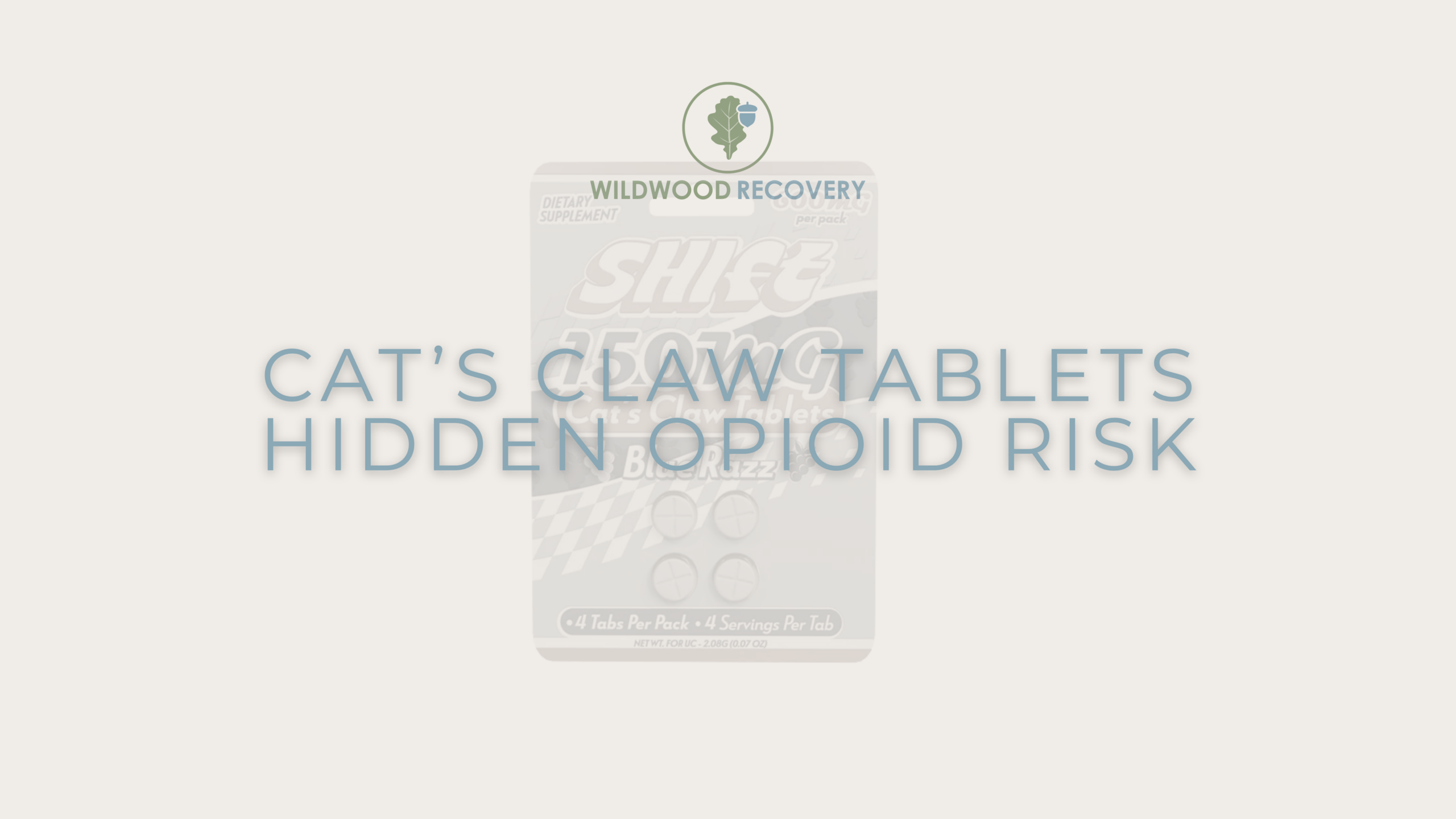
Products labeled as Cat’s Claw have recently appeared in smoke shops, convenience stores, and online marketplaces alongside kratom and 7-hydroxymitragynine tablets. Some are packaged as flavored tablets and promoted with phrases such as “proprietary botanical blend,” “7-OH free,” or “no kratom.”
The label may suggest a conventional herb. The product’s effects—and, in some cases, laboratory testing—tell a different story.
In July 2026, Utah health and agriculture officials connected severe health incidents and a death investigation to Buzzers-brand Cat’s Claw tablets. Testing found mitragynine pseudoindoxyl and MGM-15, opioid-acting compounds derived from kratom chemistry that were not clearly represented by the botanical name on the package.
This distinction matters because people may not realize they are taking an opioid-active substance until they experience sedation, escalating tolerance, withdrawal, or an overdose.
The Real Issue Is the Gap Between the Label and the Product
Most discussions of Cat’s Claw begin by comparing the herb with kratom or 7-OH. That comparison is useful, but it can miss the more immediate danger.
Consumers are being asked to make decisions from packaging that may not accurately identify what they are buying.
A person standing at a smoke-shop counter may see:
- A familiar-looking botanical name
- A milligram amount
- “No kratom” or “no 7-OH” language
- Bright, candy-like packaging
- A sealed tablet resembling other extract products
None of those details confirms the tablet’s chemical contents.
The central problem is not simply that Cat’s Claw and 7-OH are different. It is that a product can use the language of one substance while producing the effects of another.
The Three Meanings of “Cat’s Claw”
When someone mentions Cat’s Claw today, they may be referring to one of three very different things.
1. The Traditional Herb
True cat’s claw usually refers to Uncaria tomentosa or Uncaria guianensis. These woody vines are native to tropical areas of Central and South America.
Cat’s claw has a history of traditional use and is now sold in teas, capsules, and extracts. Research into its possible health effects remains limited. The National Center for Complementary and Integrative Health states that there is not enough reliable evidence to support its use for any particular health condition.
Conventional cat’s claw is not expected to produce an opioid-like high.
2. A Product Using Cat’s Claw as Part of a Blend
Some products may contain genuine cat’s claw alongside other ingredients. Those other ingredients can be more relevant to the product’s effects than the herb featured on the front label.
Terms such as “proprietary blend” can make it difficult to determine:
- Which ingredients are present
- How much of each ingredient is included
- Whether the listed milligram amount refers to one substance or the entire blend
- Whether the formulation has changed between batches
The presence of a genuine botanical ingredient does not prove that it is the ingredient producing the noticeable effects.
3. A Mislabeled Opioid-Active Product
The most serious category includes products sold as Cat’s Claw that contain undeclared or misleadingly described kratom-derived compounds.
In Utah, officials reported that tested Buzzers Cat’s Claw tablets contained mitragynine pseudoindoxyl and MGM-15. The products were associated with overdose cases, severe health incidents, and an ongoing death investigation.
That finding does not prove that every product labeled Cat’s Claw contains the same compounds. It does show why the botanical name alone can no longer be treated as reliable evidence of what is inside a smoke-shop tablet.
How Cat’s Claw Became Part of the Post-7-OH Market
Concentrated 7-OH products expanded rapidly through smoke shops, gas stations, and online sellers. They were frequently sold as tablets, shots, gummies, powders, and dissolvable strips.
Regulatory attention followed.
The FDA warned consumers that concentrated 7-OH products are potent opioid products that have not been proven safe or effective for any medical use. The agency also issued warning letters and coordinated the seizure of approximately 73,000 units of concentrated 7-OH products in December 2025.
In July 2026, the DEA announced action targeting elevated concentrations of 7-OH and three related substances:
- Mitragynine pseudoindoxyl
- MGM-15
- MGM-16
As scrutiny increased, products marketed under different botanical names began attracting attention. “Cat’s Claw” is particularly useful as a marketing label because it is the name of a real herb and may sound familiar, mild, or legally uncomplicated.
Changing the product category on the front of a package, however, does not change the pharmacology of what is inside.
“7-OH Free” Does Not Mean Opioid-Free
This may be the most important point for consumers and families to understand.
A product can contain no detectable 7-hydroxymitragynine and still contain another opioid-active compound. Mitragynine pseudoindoxyl, MGM-15, and MGM-16 are chemically distinct from 7-OH, even though they are connected to the same broader family of kratom-derived chemistry.
A narrowly worded “no 7-OH” claim may technically address one substance while saying nothing about several others.
Similar ambiguity can appear in claims such as:
- “No kratom leaf”
- “Kratom-free”
- “Natural alkaloid blend”
- “Botanical formula”
- “Research-backed extract”
- “Proprietary wellness blend”
These phrases should not be interpreted as proof that a product is non-opioid, non-addictive, or accurately labeled.
Warning Signs That a “Botanical” Tablet May Be Acting Like an Opioid
A person may not know exactly which compound they have taken. Their symptoms can still reveal that the situation is serious.
Possible opioid-like effects include:
- Unusual drowsiness or “nodding off”
- Constricted pupils
- Slowed or shallow breathing
- Difficulty staying awake
- Nausea or vomiting
- Confusion
- Poor coordination
- Bluish, gray, or unusually pale lips and skin
- Gurgling, choking, or snoring-like sounds
- Failure to respond when spoken to or shaken
If someone cannot be awakened, is not breathing normally, or appears blue or gray, call 911 immediately. Administer naloxone if it is available. Utah Poison Control specifically recommends naloxone in suspected overdoses involving the implicated Cat’s Claw products.
Emergency medical care remains necessary even if the person wakes up after receiving naloxone.
Mixing Makes an Uncertain Product More Dangerous
The risk becomes greater when the product’s actual ingredients are unknown.
Do not combine a questionable Cat’s Claw tablet with other substances that can cause sedation or suppress breathing, including:
- Alcohol
- Benzodiazepines such as Xanax, Klonopin, or Valium
- Prescription opioid pain medication
- Fentanyl or heroin
- Sleep medication
- Gabapentin or pregabalin
- Other kratom extracts or 7-OH products
When the label cannot be trusted, it is impossible to calculate a reliably safe combination.
Dependence Can Develop Before the Ingredient Is Identified
Some people discover the problem only when they try to stop.
A tablet may have been sold as a botanical aid for relaxation, pain, mood, or even 7-OH withdrawal. After repeated use, the person may begin taking it simply to feel normal or prevent withdrawal.
Possible signs of dependence include:
- Needing more tablets to get the previous effect
- Taking doses earlier or more frequently
- Waking during the night to use
- Feeling sick, anxious, or restless between doses
- Spending more money than intended
- Visiting multiple stores to maintain a supply
- Returning to 7-OH when the Cat’s Claw product is unavailable
- Continuing despite relationship, financial, health, or work problems
Withdrawal may include insomnia, sweating, chills, muscle aches, gastrointestinal problems, agitation, low mood, cravings, and severe restlessness. Our guide to 7-OH withdrawal and detox explains why opioid-like withdrawal can become difficult to manage without support.
Because products sold under the same name may contain different compounds or concentrations, another person’s withdrawal timeline cannot reliably predict what will happen in an individual case.
Why Switching From 7-OH to Cat’s Claw May Not Be a Taper
A new package can create the feeling that someone has stepped down to a safer substance. That assumption may be wrong.
If a Cat’s Claw tablet contains another opioid-active compound, switching products may only transfer dependence from one formulation to another. The person may temporarily avoid withdrawal while continuing to stimulate the same opioid system.
This can be especially misleading when the replacement product:
- Prevents 7-OH withdrawal unusually well
- Produces noticeable sedation or euphoria
- Causes tolerance to increase rapidly
- Leads to withdrawal when discontinued
- Is sold in the same format and retail environment as 7-OH tablets
A product that completely suppresses significant opioid-like withdrawal deserves caution, even if its packaging emphasizes herbs rather than kratom.
What to Do if You Have Been Taking These Products
First, avoid panic. Not every Cat’s Claw supplement is adulterated, and developing dependence does not mean recovery is out of reach.
The next step is to get accurate help.
Keep the Packaging
Bring the package, blister pack, receipt, or a clear photograph of the label to a healthcare provider. Lot numbers and ingredient claims may help identify the product.
Be Direct About the Effects
Tell the provider if the product caused sedation, euphoria, withdrawal relief, cravings, or symptoms resembling opioid withdrawal. Saying only “Cat’s Claw” may not communicate the actual clinical risk.
Do Not Guess at a Home Detox Plan
Unknown ingredients and variable potency make self-directed tapering difficult. Abruptly stopping may also create severe withdrawal for some people.
A medical or addiction professional can evaluate:
- How much and how often you have been using
- Other drugs or medications involved
- Previous opioid or 7-OH dependence
- Overdose history
- Mental health symptoms
- The safest level of care
Wildwood’s medically assisted detox program provides supervised support for people who may need help managing withdrawal safely.
Keep Naloxone Available
Anyone using a tablet that may contain an opioid-active ingredient should have naloxone nearby. Family members should know where it is and how to use it.
Contact Poison Control
For immediate guidance after an unexpected reaction, call the Poison Help Line at 1-800-222-1222. The service is free and available 24 hours a day in the United States.
Treatment for Cat’s Claw, 7-OH, or Kratom-Derivative Dependence
Treatment should be based on what the person is experiencing—not solely on the product name.
Depending on individual needs, care may include:
- Medical assessment
- Supervised withdrawal management
- Medication-assisted treatment when clinically appropriate
- Monitoring for dehydration or other complications
- Individual and group therapy
- Treatment for anxiety, depression, trauma, or chronic pain
- Relapse-prevention planning
- Family education
- Ongoing outpatient support
People experiencing dependence on these products may benefit from the same comprehensive approach used in opioid addiction treatment. When anxiety, depression, trauma, or another condition is also present, dual diagnosis treatment can address substance use and mental health together.
Honesty about the uncertainty is important. A clinician may not know the exact compound immediately, but opioid-like symptoms, dependence, and withdrawal can still be recognized and treated.
Frequently Asked Questions About Cat’s Claw and 7-OH Products
Is Cat’s Claw the same as 7-OH?
No. Authentic cat’s claw is a woody vine, while 7-OH is an opioid-active alkaloid associated with kratom. The current concern is that some tablets marketed as Cat’s Claw may contain undeclared kratom-derived opioid compounds.
Does every Cat’s Claw supplement contain opioids?
No. Conventional herbal supplements may contain genuine Uncaria tomentosa. The warnings discussed here concern certain tablet and blend products sold through smoke shops, convenience stores, and similar markets.
Can a product be “7-OH free” and still act like an opioid?
Yes. Other compounds—including mitragynine pseudoindoxyl and MGM-15—can be opioid-active without being 7-OH. A “7-OH free” claim should not be interpreted as an “opioid-free” guarantee.
What was found in the tested Utah products?
Utah officials reported finding mitragynine pseudoindoxyl and MGM-15 in tested Buzzers-brand Cat’s Claw tablets. Officials associated the products with several severe health incidents and an ongoing death investigation.
How can I tell whether a Cat’s Claw product is the real herb?
Look for the full botanical name, Uncaria tomentosa or Uncaria guianensis, along with a transparent ingredient list and credible independent testing. Be especially cautious with flavored pressed tablets, products sold beside 7-OH extracts, proprietary blends, and packages making unusually strong mood or pain claims.
Visual inspection alone cannot confirm a product’s contents.
What does genuine cat’s claw feel like?
A conventional cat’s claw supplement is not expected to produce opioid-like euphoria, nodding, heavy sedation, or immediate withdrawal relief. Experiencing those effects is a reason to stop treating the product as an ordinary herbal supplement.
Can naloxone reverse an overdose from these products?
Naloxone should be administered when an opioid overdose is suspected. Utah Poison Control recommends its use in suspected overdoses involving the identified products. Always call 911, even if the person becomes responsive.
What are the signs of an overdose?
Warning signs include an inability to wake the person, slow or absent breathing, blue or gray lips, pinpoint pupils, limpness, vomiting, and gurgling or snoring-like sounds. Call 911 immediately and give naloxone if available.
Can Cat’s Claw tablets cause withdrawal?
A genuine cat’s claw supplement is not expected to cause opioid withdrawal. A mislabeled product containing opioid-active compounds may lead to tolerance, physical dependence, and withdrawal with repeated use.
How long does withdrawal from a mislabeled product last?
There is no reliable universal timeline because the actual compound, potency, dose, and batch may be unknown. Duration can also be affected by frequency of use, other substances, health conditions, and previous opioid dependence.
Is it safe to use Cat’s Claw to stop 7-OH?
A smoke-shop tablet labeled Cat’s Claw should not be assumed to be a safe tapering product. If it suppresses 7-OH withdrawal, it may be maintaining opioid dependence through another compound.
Should I quit Cat’s Claw tablets cold turkey?
That decision should be made with a qualified healthcare professional, particularly after frequent or high-dose use. Unknown ingredients make withdrawal difficult to predict, and medical supervision may be safer for people with severe symptoms, co-occurring substance use, or previous relapse.
Can these products be mixed safely with alcohol or anxiety medication?
They should not be assumed safe to combine with alcohol, benzodiazepines, opioids, sleep medications, or other sedating substances. Combining central nervous system depressants can increase the risk of profound sedation and slowed breathing.
What should I tell a doctor if I do not know what was in the product?
Bring the packaging and describe the effects rather than relying only on the product name. Explain whether it caused sedation, euphoria, withdrawal relief, increased tolerance, cravings, or withdrawal symptoms between doses.
When should someone seek professional treatment?
Consider professional help if you cannot stop, need the product to feel normal, experience withdrawal between doses, have overdosed, repeatedly return to use, mix it with other substances, or see your health, work, finances, or relationships deteriorating.
Wildwood offers multiple levels of care, including drug addiction treatment, an intensive outpatient program, and family therapy.
The Label Is Not the Diagnosis
The emergence of opioid-active products under the Cat’s Claw name reflects a larger change in the unregulated extract market. When one substance receives regulatory attention, packaging may change faster than the underlying chemistry.
Consumers should not have to identify experimental opioids by trial and error. Until testing and oversight catch up, the safest response is to take unexpected opioid-like effects seriously, regardless of the plant pictured on the package.
If you are using Cat’s Claw, 7-OH, or another extract every day and are afraid of what will happen when you stop, you do not have to solve the chemistry before asking for help.
Wildwood Recovery provides individualized treatment for substance dependence and co-occurring mental health concerns in Thousand Oaks, California. Call 1-805-301-6862 or contact Wildwood Recovery to discuss available support.
References
Drug Enforcement Administration. (2026, July 1). DEA to temporarily schedule 7-OH and related substances to protect public safety. Retrieved from: https://www.dea.gov/press-releases/2026/07/01/dea-temporarily-schedule-7-oh-and-related-substances-protect-public
National Center for Complementary and Integrative Health. (n.d.). Cat’s claw: Usefulness and safety. U.S. Department of Health and Human Services. Retrieved September 17, 2026, from: https://www.nccih.nih.gov/health/cats-claw
U.S. Food and Drug Administration. (2025, July 29). Products containing 7-OH can cause serious harm. Retrieved from: https://www.fda.gov/consumers/consumer-updates/products-containing-7-oh-can-cause-serious-harm
U.S. Food and Drug Administration. (2025, December 2). FDA seizes 7-OH opioids to protect American consumers. Retrieved from: https://www.fda.gov/news-events/press-announcements/fda-seizes-7-oh-opioids-protect-american-consumers
U.S. Food and Drug Administration. (2026). Hiding in plain sight: 7-OH products. Retrieved from: https://www.fda.gov/news-events/public-health-focus/hiding-plain-sight-7-oh-products
Utah Department of Agriculture and Food. (2026, July 30). Illegal kratom product sold in Utah County linked to death in Utah. Retrieved from: https://ag.utah.gov/news/illegal-kratom-product-sold-in-utah-county-linked-to-death-in-utah/
Utah Poison Control Center. (2026, July 22). Adulterated Cat’s Claw and kava products may cause opioid overdose. Retrieved from: https://poisoncontrol.utah.edu/news/2026/07/adulterated-cats-claw-and-kava-products-may-cause-opioid-overdose