
For many people, 7-OH did not start as “drug use.”
It may have started as something sold at a smoke shop, gas station, or online store. Maybe it was marketed as kratom, a plant-based mood booster, a pain relief product, or a legal alternative to opioids. The packaging may have looked clean. The product may have been easy to buy. At first, it may have seemed like something that helped.
Then the pattern changed.
The dose got higher. The effects did not last as long. The body started expecting it. Stopping caused sweats, chills, anxiety, stomach issues, restlessness, insomnia, or a deep sense of panic. What once felt like a choice started to feel like something the body demanded.
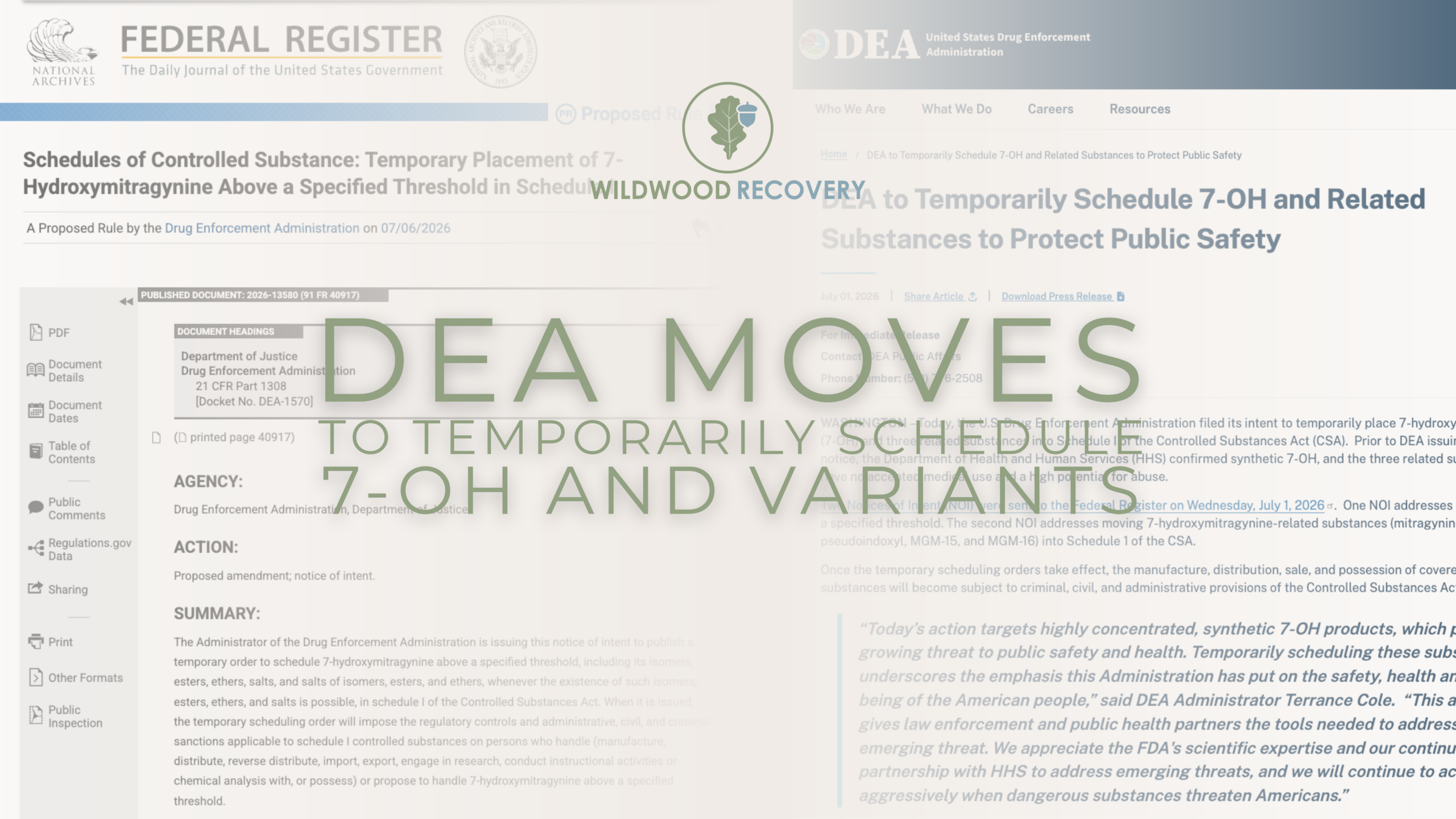
Now, the Drug Enforcement Administration is moving to temporarily schedule certain 7-hydroxymitragynine products, commonly called 7-OH, along with related substances. For people who have already become dependent on these products, the announcement can feel overwhelming. It may bring up fear about withdrawal, fear about losing access, and fear about what happens next. At Wildwood, we believe this is not a moment for shame. It is a moment to get support.
What Is 7-OH?
7-OH stands for 7-hydroxymitragynine. It is an alkaloid associated with kratom, but concentrated 7-OH products are not the same thing as traditional kratom leaf.
In natural kratom, 7-OH is typically present in very small amounts. The concern now is with products that contain concentrated, enhanced, or chemically altered forms of 7-OH. These products may be sold as tablets, gummies, powders, shots, or capsules, and some may contain much higher levels of 7-OH than a person would get from plain kratom leaf.
That difference matters.
Many people using 7-OH products may believe they are taking something mild because it is sold legally or marketed as plant-based. But concentrated 7-OH can create opioid-like effects, and for some people, it can also lead to tolerance, dependence, and withdrawal.
What Did the DEA Announce About 7-OH?
On July 1, 2026, the DEA announced its intent to temporarily schedule certain 7-OH products and related substances. The action focuses on 7-OH above a specified threshold, along with related substances such as mitragynine pseudoindoxyl, MGM-15, and MGM-16.
Temporary scheduling is a federal process that allows the DEA to place a substance into Schedule I when the agency believes it poses an imminent hazard to public safety. Schedule I is the most restrictive category under federal controlled substance law.
The important point for people using 7-OH is this: the government is signaling that concentrated 7-OH products are no longer being treated like ordinary wellness products. Regulators are viewing them as substances with serious abuse, dependence, and public health concerns.
Why This Announcement Matters for People Already Using 7-OH
Legal changes do not erase dependence.
If someone has been using 7-OH every day, a federal scheduling announcement does not suddenly make withdrawal disappear. It does not solve cravings. It does not address the anxiety that comes with losing access. It does not help someone safely taper, sleep, function at work, or avoid returning to more dangerous substances.
That is why this issue needs more than enforcement. It needs treatment access.
When a substance becomes harder to buy, people who are dependent may react in risky ways. Some may stockpile. Some may abruptly stop and go through withdrawal alone. Some may search for replacement products online. Some may switch to other kratom extracts, research chemicals, counterfeit pills, or illicit opioids.
That risk is especially serious for people who started using 7-OH to manage opioid withdrawal or avoid returning to fentanyl, heroin, or pain pills.
The safest next step is not panic. It is planning.
Signs 7-OH Use Has Become a Problem
7-OH use may be becoming dependence when the product is no longer being used occasionally or casually, but instead becomes something a person feels they need to get through the day.
Warning signs may include:
- Using 7-OH every day or multiple times per day
- Feeling sick, anxious, or restless when a dose is missed
- Waking up in withdrawal
- Taking more than planned
- Needing higher doses to feel the same effect
- Spending more money than intended
- Hiding use from family, friends, or coworkers
- Feeling afraid to run out
- Trying to stop but returning to use because withdrawal feels too intense
- Using 7-OH to avoid opioid withdrawal
- Thinking about switching to another substance if 7-OH becomes unavailable
A person does not need to meet every sign on this list to deserve help. If 7-OH has started to control your day, it is worth taking seriously.
What 7-OH Withdrawal Can Feel Like
People who stop or reduce 7-OH after regular use may experience withdrawal symptoms. The intensity can vary depending on how much someone has been taking, how often they use it, how long they have used it, and whether other substances are involved.
Possible symptoms may include:
- Sweating
- Chills or hot flashes
- Anxiety
- Irritability
- Restlessness
- Muscle aches
- Nausea
- Diarrhea
- Runny nose
- Watery eyes
- Insomnia
- Fatigue
- Low mood
- Cravings
For some people, withdrawal is uncomfortable but manageable. For others, it can feel intense enough that they return to use just to function. This is one of the reasons professional support can be so important.
The goal is not simply to “get through withdrawal.” The goal is to stabilize safely and reduce the risk of returning to 7-OH or moving to something more dangerous.
7-OH, Kratom, and Opioid-Like Dependence
One of the hardest parts of 7-OH dependence is that many people do not know what category to put it in. They may not think of it as an opioid. They may not think of it as relapse. They may not think of it as addiction because it came from a store and was not purchased illegally.
But the body does not judge a substance by its packaging.
If a product creates opioid-like effects, leads to tolerance, causes withdrawal, and becomes difficult to stop, it deserves serious clinical attention. That does not mean the person is bad. It does not mean they failed. It means the nervous system and body have adapted to a substance that may be much stronger than the person originally understood.
For people in recovery from opioid addiction, this can be emotionally complicated. Someone may have used 7-OH believing it was safer than opioids or separate from their recovery. Then, once dependence develops, they may feel guilt, fear, or secrecy.
Wildwood approaches this with compassion. The priority is not labeling or shaming. The priority is helping the person get safe.
Why “Just Stop Taking It” Is Not Always Realistic
When people hear about a substance being banned or scheduled, they may assume the solution is simple: stop.
But for someone who is physically dependent, stopping suddenly can be difficult and sometimes risky. Withdrawal symptoms can interfere with sleep, work, parenting, mental health, and decision-making. Cravings can become intense. If someone has a history of opioid use disorder, untreated withdrawal may increase the risk of returning to illicit opioids.
That is why a treatment plan matters.
A safe plan may include medical evaluation, withdrawal support, therapy, relapse prevention, and, when appropriate, medication-assisted treatment. The goal is to help the person move from fear and instability into a more manageable path forward.
Can Medication-Assisted Treatment Help?
Medication-assisted treatment, often called MAT, is commonly used to treat opioid use disorder. MAT may include medications such as buprenorphine, methadone, or naltrexone, along with counseling and recovery support.
There is no single FDA-approved medication specifically for 7-OH dependence. However, because many people report opioid-like effects and opioid-like withdrawal from concentrated 7-OH products, a qualified medical provider may assess whether MAT is appropriate based on the person’s symptoms, substance use history, and relapse risk.
This can be especially important for people who:
- Have a history of opioid addiction
- Were using 7-OH to avoid opioid withdrawal
- Are afraid they may return to fentanyl, heroin, or pills
- Cannot stop using 7-OH because withdrawal is too intense
- Have tried to taper but keep returning to use
MAT is not about replacing one problem with another. When used appropriately and supervised by medical professionals, it can reduce cravings, support stability, lower overdose risk, and give people the space to work on recovery.
For someone facing 7-OH dependence, supervised care is safer than guessing with unregulated products, ordering unknown substitutes, or trying to white-knuckle withdrawal alone.
What About MGM-15, MGM-16, and Other 7-OH Analogs?
The DEA action also involves substances related to 7-OH, including MGM-15, MGM-16, and mitragynine pseudoindoxyl. These compounds are part of the broader concern around chemically altered or highly potent kratom-related products.
This matters because when one substance becomes restricted, the market often shifts. New products may appear with slightly different names, altered formulas, or labels that avoid banned language. These products may be marketed as legal replacements, but that does not mean they are safer.
In fact, replacement products can be especially risky because the safety data may be limited, potency may be unclear, and consumers may not know what they are actually taking.
If you are already dependent on 7-OH, switching to a new analog is not a safe long-term plan. Clinical support is a better option than chasing the next unregulated substitute.
What Should You Do If You Are Using 7-OH Right Now?
If you are using 7-OH occasionally and are concerned, it may be time to stop before dependence deepens.
If you are using 7-OH daily, waking up in withdrawal, or feeling afraid to run out, it may be safer to speak with a treatment professional instead of trying to manage it alone.
You may want to reach out for help if:
- You are physically dependent on 7-OH
- You are worried about the DEA scheduling action
- You are afraid of withdrawal
- You are using more than you used to
- You have tried to quit and could not
- You are hiding your use
- You are considering switching to other substances
- You have a history of opioid use disorder
- Your mental health is getting worse
- You feel trapped by the cycle
Getting help does not mean you are weak. It means you are responding to a real problem with a real plan.
How Wildwood Can Help
Wildwood supports people who are struggling with substance use, dependence, withdrawal concerns, and co-occurring mental health symptoms. If 7-OH has become part of your daily life, or if the DEA announcement has made you realize you need help before access changes, Wildwood can help you understand your options.
Treatment may include clinical assessment, withdrawal support, therapy, relapse prevention, and coordination of medication-assisted treatment when appropriate. The goal is to help you stabilize safely and build a path forward that does not depend on smoke shop products, online substitutes, or fear of withdrawal.
You do not have to wait until the law changes. You do not have to wait until you run out. You do not have to wait until things get worse.
If 7-OH has become hard to stop, help is available now.
Final Thoughts
The DEA’s temporary scheduling action against 7-OH is a major shift in how federal regulators are responding to concentrated kratom-related products. But for people already using these products, the issue is not only legal. It is personal, physical, and urgent.
A product can be sold legally and still become dangerous. A person can become dependent without meaning to. And someone can need help without deserving shame.
If you are worried about 7-OH withdrawal, dependence, or what happens next, Wildwood is here to help you take the next step safely.
Sources
Drug Enforcement Administration. (2026, July 1). DEA to temporarily schedule 7-OH and related substances to protect public safety. U.S. Department of Justice. https://www.dea.gov/press-releases/2026/07/01/dea-temporarily-schedule-7-oh-and-related-substances-protect-public
Drug Enforcement Administration. (2026, July 6). Schedules of controlled substances: Temporary placement of 7-hydroxymitragynine above a specified threshold in schedule I. Federal Register. https://www.federalregister.gov/documents/2026/07/06/2026-13580/schedules-of-controlled-substance-temporary-placement-of-7-hydroxymitragynine-above-a-specified
U.S. Department of Health and Human Services. (2026, July 5). HHS, FDA commend DEA action against dangerous 7-OH and synthetic opioid derivatives. https://www.hhs.gov/press-room/hhs-fda-support-dea-7-oh-scheduling.html
U.S. Food and Drug Administration. (2025, July 29). FDA takes steps to restrict 7-OH opioid products threatening American consumers. https://www.fda.gov/news-events/press-announcements/fda-takes-steps-restrict-7-oh-opioid-products-threatening-american-consumers
Pierson, B. (2026, July 1). DEA moves to place some strong kratom-related products under strict federal drug controls. Reuters. https://www.reuters.com/legal/litigation/dea-moves-place-some-strong-kratom-related-products-under-strict-federal-drug-2026-07-01/
Klee, M. (2026, July 2). The DEA plans to ban opioid-like kratom compound 7-OH. WIRED. https://www.wired.com/story/the-dea-plans-to-ban-kratom-compound-7-oh-sold-as-a-gas-station-opioid/
National Institute on Drug Abuse. (2024, September 27). Kratom. National Institutes of Health. https://nida.nih.gov/research-topics/kratom
U.S. Food and Drug Administration. (2026, February 21). FDA and kratom. https://www.fda.gov/news-events/public-health-focus/fda-and-kratom